
OVERVIEW
Asia — and the world — needs urgent action
There is “no credible pathway to 1.5°C in place” today, said the Emissions Gap Report 2022 of the United Nations Environment Programme. The Earth is on track to exceed 1.5°C warming within the next decade. Countries’ nationally determined contributions need to be increased by at least 23 gigatonnes of carbon-dioxide equivalents to achieve the world’s 2030 climate target.
Asia and the Pacific, despite covering only 7% of the Earth’s land surface, are home to nearly two-thirds of the world’s floral and faunal diversity, store 68% of carbon stocks, and provide shelter to 85.7 million people. However, between 1990 and 2020, deforestation in Asian tropical forests soared to 15%, with 37.6 million hectares lost—far exceeding the global average of 4%. The potential for restoring these degraded lands is immense, offering large-scale opportunities to sequester atmospheric carbon. An additional 300 million hectares can be repurposed for mosaic-landscape restoration, combining trees and forests with other land uses to enhance carbon capture, livelihoods, and ecosystem health.
AFoCO Climate Action Plan (2025-2034)
The Climate Action Plan is a program under the AFoCO Strategic Plan (2024–2030). The Climate Action Plan puts major effort into assisting Member Countries enhance their contributions to achieving the Paris Agreement’s goals and accelerate efforts to remove large amounts of atmospheric carbon to stabilize global temperatures.
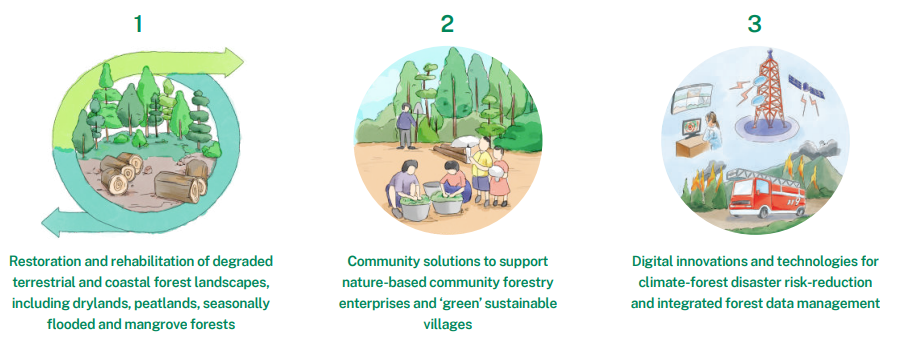
Table: Visual Introduction to AFoCO Climate Action Plan (2025-2034)
In response to escalating climate-related challenges affecting forests and forest-dependent communities across Asia, AFoCO has progressively established a set of complementary regional initiatives to operationalize its Climate Action Plan (2025–2034), in alignment with the AFoCO Strategic Plan (2024–2030). Building on the early establishment of Landscape Partnership Asia (LPA) in 2022 as a multi-partner platform for landscape restoration and nature-based solutions, AFoCO further consolidated its climate action framework through the endorsement of four additional initiatives at the Eleventh (11th) Session of the Assembly in 2024: the Asian Forest Living Lab Initiative, the Forest Fire Management in Asia (FFMA) Initiative, the AFoCO Mangrove Initiative, and the REDD+ Readiness Initiative.
Together, these five initiatives form an integrated and mutually reinforcing portfolio that addresses key climate–forest priorities, including science-based innovation, disaster risk management, ecosystem and landscape restoration, coastal resilience, and readiness for climate finance and carbon markets. Designed to respond to the diverse capacities and needs of Member Countries, the initiatives provide scalable platforms for regional cooperation, technical capacity development, and multi-stakeholder partnerships, thereby strengthening AFoCO’s collective contribution to climate-resilient forests, sustainable livelihoods, and the achievement of regional and global climate and development commitments.
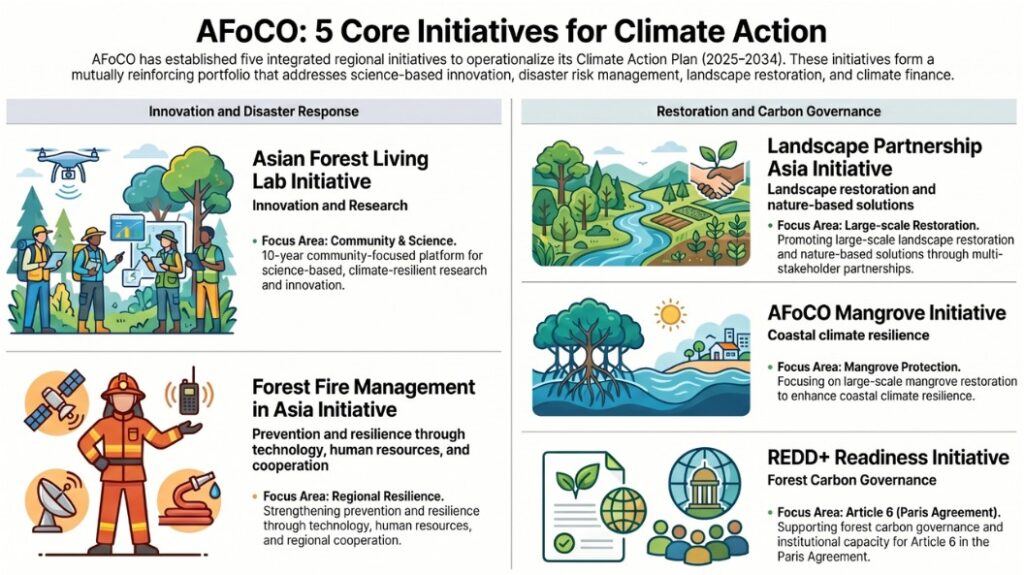
Table: Visual Introduction to the 5 AFoCO Initiatives