
Following last year’s Blended Finance Session at the AFoCO General Assembly and the subsequent webinar on “Advancing the Forest-Positive Economy in Indonesia,” AFoCO is taking one step further: how can forests, communities, markets, and finance can work together to build more resilient and forest-positive economies?
In September 2026, AFoCO convened an Executive Roundtable in Singapore with representatives from governments, companies, investors, development finance institutions, NGOs, and landscape actors to explore an emerging idea: the Forest-Positive Economies Platform.
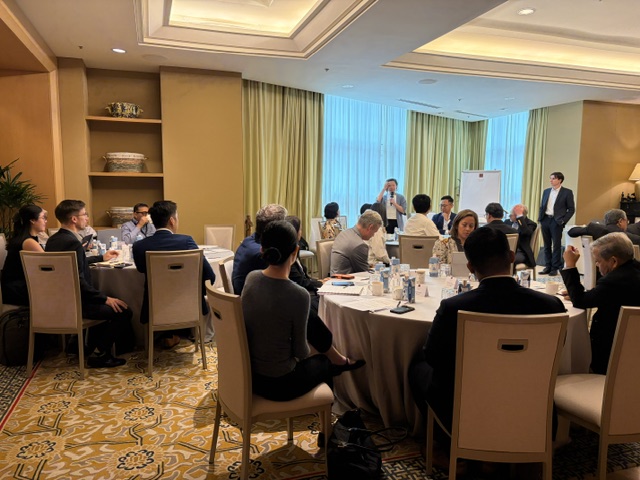
The Roundtable brought together a diverse group of organizations spanning government, finance, global value chains, development cooperation, and civil society. Participants included representatives from the Ministry of Forestry of Indonesia, Artha Networks Inc., Asian Development Bank (ADB), GIZ, Mars, Barry Callebaut, Olam Agri, Golden Agri-Resources, Michelin, Pirelli, Shell, Beneficial Returns, AfterOil, Save the Children, TerraFormation, the Economics of Mutuality Foundation, and other organizations working across sustainable landscapes, carbon markets, and impact investment. This mix of perspectives created a timely opportunity to examine the same landscape challenges through the lenses of policy, production, procurement, community resilience, and capital.
Connecting the Pieces
Across forest and agricultural landscapes, many actors are already working towards sustainable development, but their efforts often remain fragmented.
Farmers may have products but limited access to reliable markets. Companies seek resilient and sustainable supply chains but can struggle to connect with producers. Governments have priorities and programs, but coordination can be challenging. Investors have capital, but often lack investment-ready opportunities.
The common need is simple: better connections between government priorities, landscape needs, market demand, and capital.
The Platform is being explored as a way to strengthen these connections while building on existing initiatives, rather than creating another parallel mechanism.
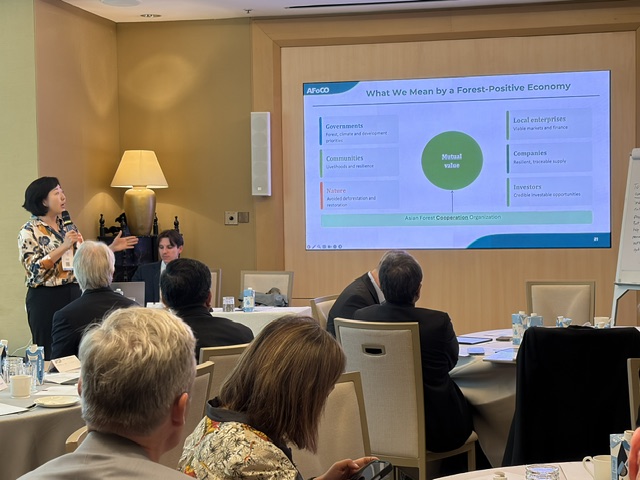
Learning from Central Sulawesi
Central Sulawesi, Indonesia, provided a practical landscape case for the discussion. Drawing on ongoing work, participants explored the perspectives of farming communities, governments, buyers, and investors, and what each can contribute and needs from others.
The discussion highlighted common challenges around coordination, market access, diversified livelihoods, evidence and risk-sharing. It also raised a broader question: how can we move from frangmented interventions toward shared outcomes?
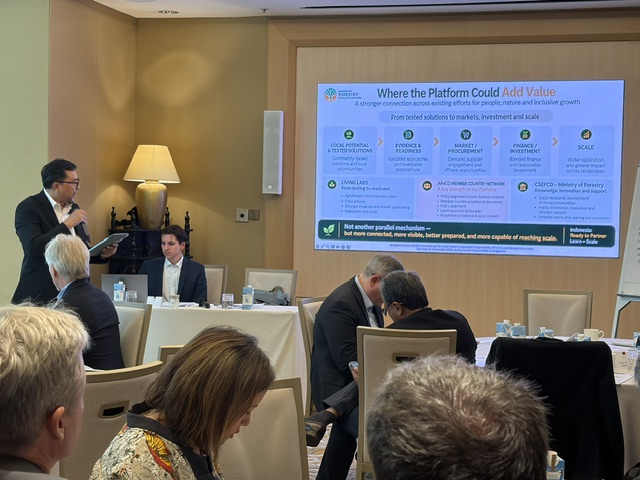
From Living Labs to Markets
Living Labs could provide a space to bring these pieces together. Rather than serving only as a demonstration sites, they could connect government priorities, community needs, technical solutions, evidence, market demand, and finance.
The potential pathway is:
Testing solutions → Generating evidence → Building readiness → Connecting to markets and capital → Enabling replication
The aim is not only to prepare opportunities for investment, but also to strengthen coordination while keeping community livelihoods, ecological integrity, and biodiversity at the center.
Where Markets and Finance Meet Forests
A forest-positive economy also needs functioning economic pathways.
Smallholders often produce multiple commodities, while market interventions are frequently organized around individual supply chains. Connecting producers with a wider range of buyers, strengthening procurement and offtake, and supporting more diverse livelihoods can help build greater resilience across landscapes.
Finance is another important piece. Uncertain revenues, fragmented producers, limited collateral, long investment horizons, and high transaction costs can make landscape investments difficult to finance. Blended finance and other risk-sharing approaches can help address these barriers and bring more capital into viable opportunities.
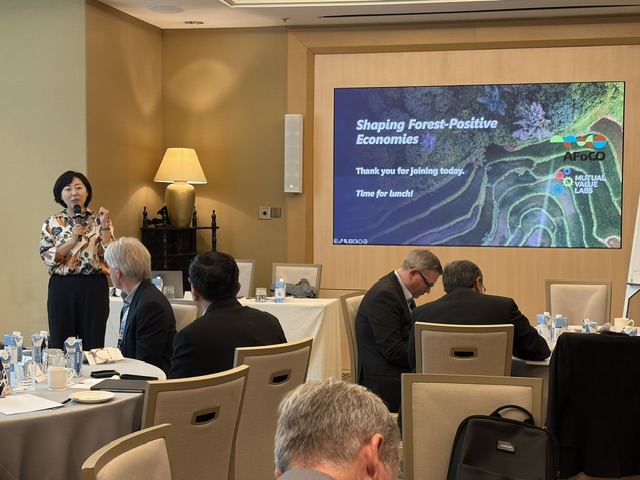
From Central Sulawesi to the Region
Central Sulawesi is a starting point, not the destination. Through its regional network, AFoCO can help connect country priorities, support landscape-level coordination, share learning across Member Countries, and link emerging opportunities with market and financial partners.
The Forest-Positive Economies Platform is still taking shape. Its ambition is straightforward: to help build economic systems where forests, communities, sustainable businesses, and responsible investment can grow together.
From landscapes to markets, and from individual projects to shared solutions, AFoCO is exploring a new pathway towards forest-positive economies across Asia.

Submitted by Somin Oh, Program Officer, Blended Finance Division