
On 12 February 2026, AFoCO participated in the Round Table entitled “Enhancing Global and Regional Mountain Dialogue: Towards the Second Global Mountain Summit ‘Bishkek+25’” held in Seoul.
The event was convened to advance the implementation of the United Nations–proclaimed Five Years of Action for the Development of Mountain Regions (2023–2027) and to strengthen international cooperation in preparation for the Second Global Mountain Summit “Bishkek+25”.
Government representatives from Central Asia and the Republic of Korea, along with international organizations and research institutions, gathered to discuss climate resilience, sustainable mountain development, and financing mechanisms for scaling solutions.

Strengthening Regional Dialogue on Mountain Resilience
The opening session featured welcoming remarks by Mr. Rhee Jong Kook, Executive Director of the Korea–Central Asia Cooperation Forum Secretariat; H.E. Ms. Aida Ismailova, Ambassador of the Kyrgyz Republic to the Republic of Korea; and Ms. Sunhee Ryu, Director of UNESCO i-WSSM. The speakers underscored the strategic importance of mountain ecosystems in Central Asia and the need for strengthened regional cooperation in addressing climate and water-related challenges.
In her keynote address, Ms. Dinara Kemelova, Special Representative of the President of the Kyrgyz Republic on the Mountain Agenda, outlined the progress and priorities under the Five Years of Action for the Development of Mountain Regions (2023–2027). She highlighted the critical role of the Tien Shan and Pamir mountain systems as the “water towers” of Central Asia, emphasizing that accelerating glacier retreat, land degradation, landslides, and floods pose serious risks to water security, livelihoods, and biodiversity. She stressed that Bishkek+25 should serve not merely as a high-level dialogue, but as a platform for delivering concrete, scalable initiatives.
Integrated Approaches and Climate Finance Mobilization
Participants agreed that mountain challenges must be addressed through integrated environmental, economic, and social approaches. Priority areas for cooperation include:
- Forest and landscape restoration
- Biodiversity conservation
- Climate resilience and disaster risk reduction
- Science-based research and data collaboration
- Improved access to climate finance
The discussions emphasized the importance of connecting policy dialogue with implementation-ready projects and sustainable financing pathways.
AFoCO’s Forest-Based Cooperation Model
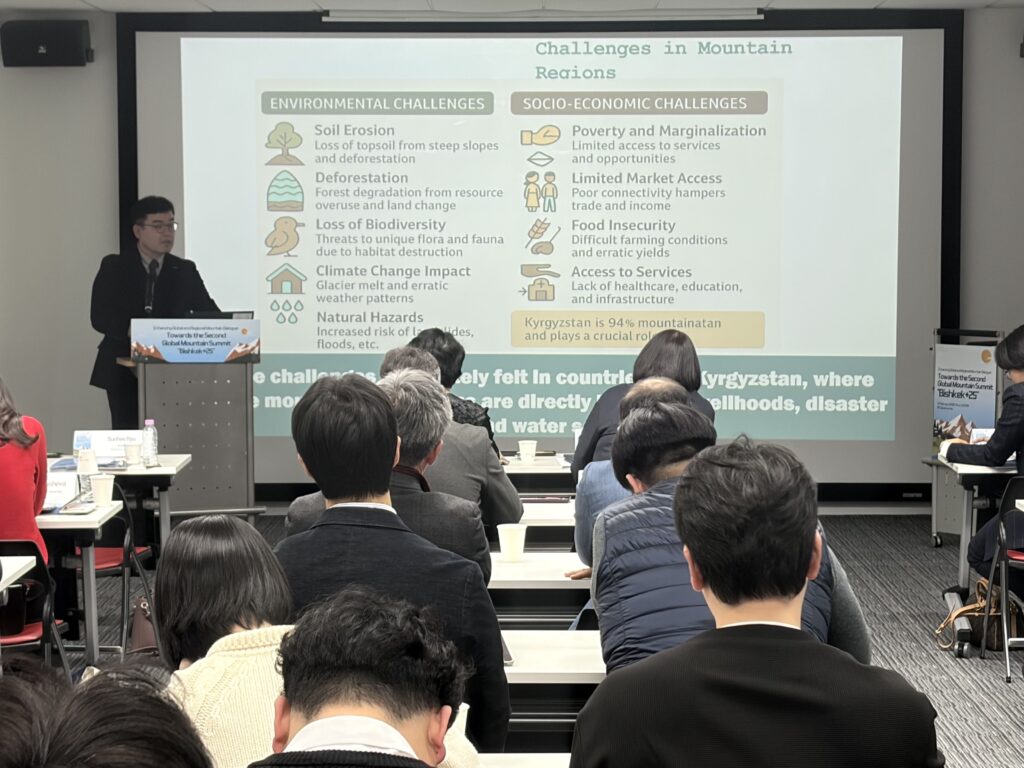
During the session, AFoCO presented its approach to public–private partnership (PPP)-based climate initiatives in forest and mountain regions.
The presentation highlighted the need to transform forests from being viewed solely as carbon sinks into scalable nature-based climate solutions. AFoCO introduced the concept of adding a “carbon layer” to existing forestry and development projects to enhance their investment readiness, alongside a blended finance pathway that links public funding, multilateral development support, and private capital.
A case from Kyrgyzstan was shared, illustrating a smallholder-based agroforestry carbon model supported by digital MRV systems. The model demonstrates how early-stage public support can help de-risk projects and attract private sector participation, thereby strengthening both climate mitigation outcomes and local livelihoods.
Through its treaty-based intergovernmental framework and cooperation with its 17 Member Countries, AFoCO continues to promote policy-aligned, standards-based, and community-centered forest initiatives across Asia.
Toward Bishkek+25
The Round Table reaffirmed the shared commitment to positioning Central Asia as a pilot region for scalable mountain and forest-based climate solutions. Participants emphasized that Bishkek+25 should present concrete project pipelines and strengthened partnerships that move beyond declarations toward implementation.
AFoCO will continue to work closely with its Member Countries and international partners to structure and scale forest-based climate initiatives, strengthen science-based monitoring and verification systems, and promote the expansion of public–private partnership models.