
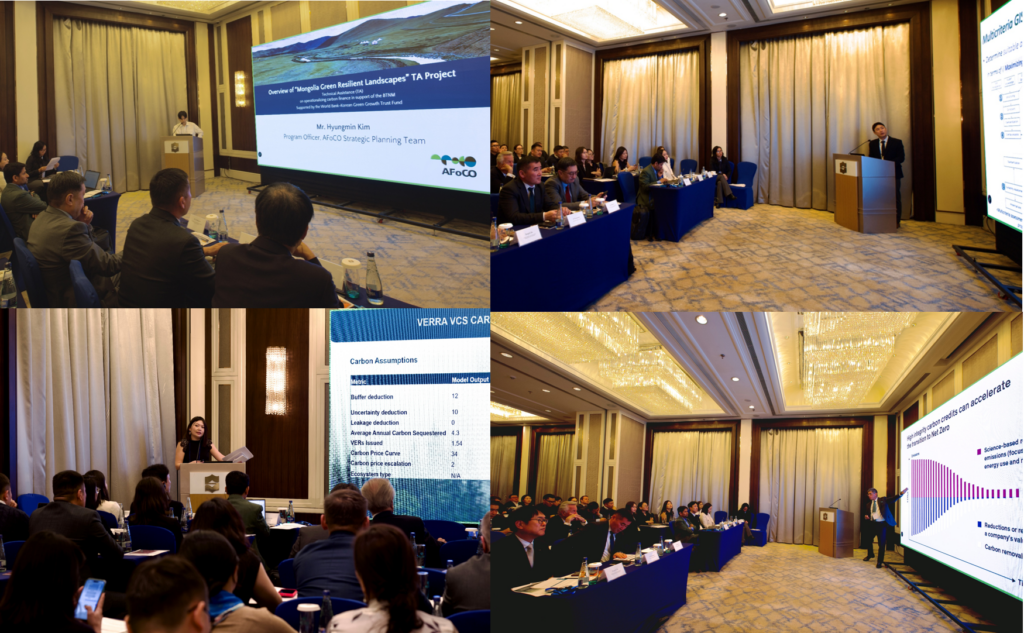
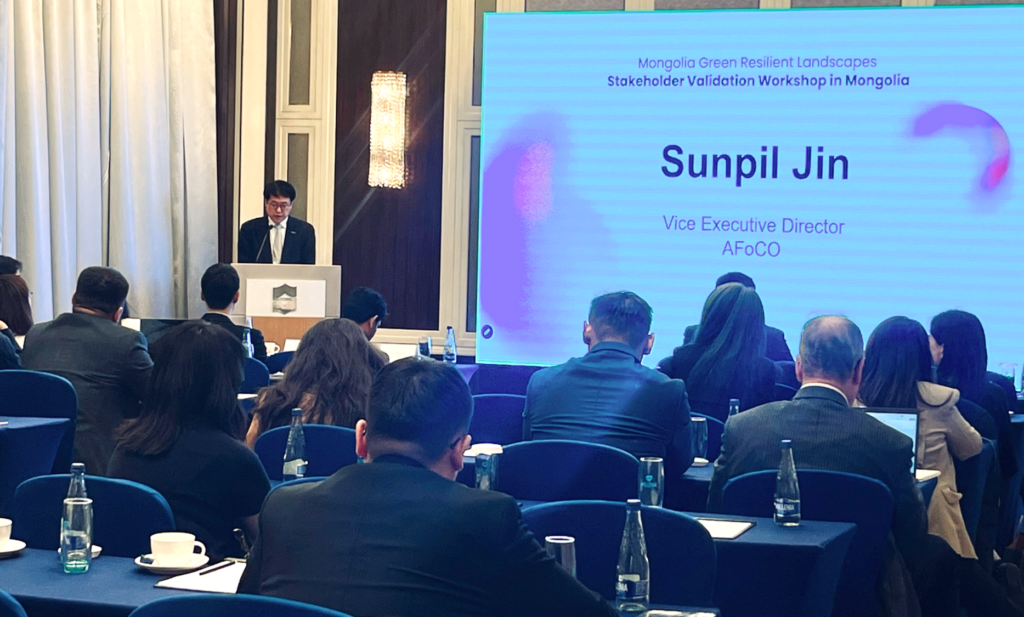
Ulaanbaatar, Mongolia | March 31, 2026 —The Asian Forest Cooperation Organization (AFoCO) in co- organization with Mongolia’s National Forest Agency(NFA), Business Council of Mongolia (BCM), convened a Stakeholder Validation Workshop at the Shangri-La Hotel in Ulaanbaatar to present and validate three Green Investment Plans (GIPs) developed under the Mongolia Green Resilient Landscapes Technical Assistance(TA) Program.
The program supports the Government of Mongolia in raising the ambition of its Nationally Determined Contribution through the Mongolia’s Billion Trees National Movement (BTNM).
The workshop brought together the representatives from the Government of Mongolia, development partners, financial institutions, private sector actors, and technical experts. together investors, development finance institutions, private sector actors, and government officials.
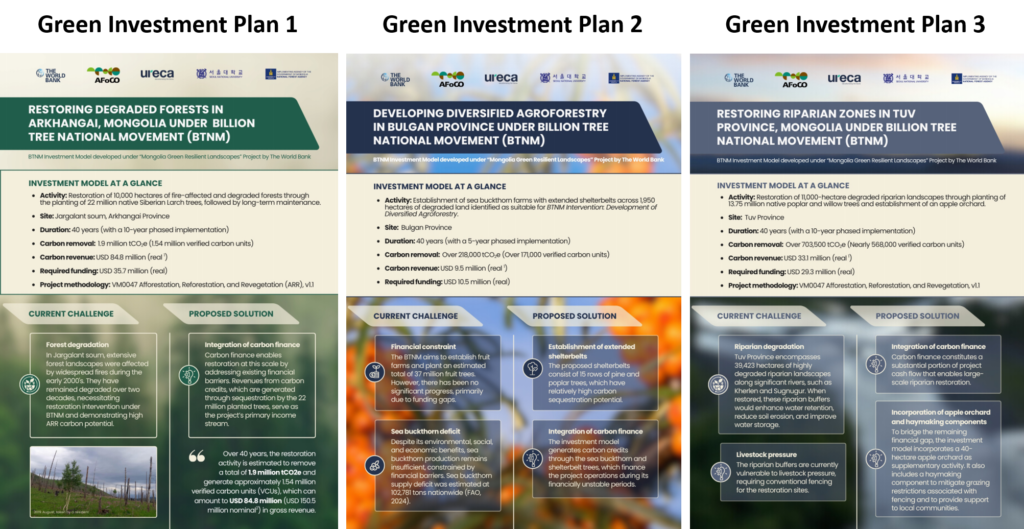
The GIPs were introduced as bankable, investor ready opportunities aligned with Mongolia’s forest landscape restoration priorities. Each plan targets a distinct province and intervention type: forest restoration in Arkhangai, sea buckthorn agroforestry in Bulgan, and riparian zone rehabilitation in Tuv Province.
The first GIP, “Restoring Degraded Forests in Arkhangai Province,” proposes to restore 10,000 hectares of fire-affected and degraded forest through planting 22 million Siberian Larch trees, projecting removal of 1.9 million tCO₂e and carbon revenues of USD 84.8 million over 40 years.
The second GIP, “Developing Diversified Agroforestry in Bulgan Province,” proposes sea buckthorn farms with extended shelterbelts across 1,950 hectares, projecting removal of over 218,000 tCO₂e and carbon revenues of USD 9.5 million.
The third GIP, “Restoring Riparian Zones in Tuv Province,” proposes restoration of 11,000 hectares through planting 13.75 million native poplar and willow trees, projecting removal of over 703,500 tCO₂e and carbon revenues of USD 33.1 million.
Discussions focused on the investment rationale, implementation feasibility, financing arrangements, risk factors, and opportunities for future collaboration of GIPs, and helped identify potential interest from both public and private stakeholders for follow-up cooperation and future investment development.
Discussions focused on the investment rationale, implementation feasibility, financing arrangements, risk factors, and opportunities for future collaboration of GIPs, and helped identify potential interest from both public and private stakeholders for follow-up cooperation and future investment development.
The workshop served as an important opportunity to present the GIPs to a broader group of stakeholders and to collect feedback for further refinement.
Contributed by Ms. Young Kim (Assistant Program Officer)